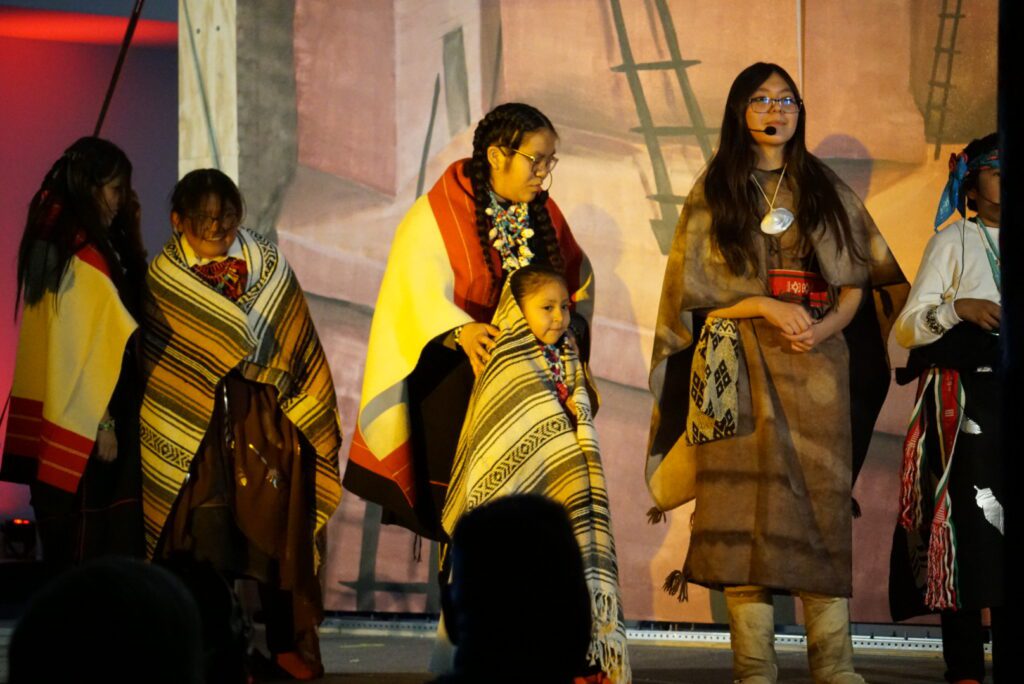

ZUNI, N.M. (Feb. 27, 2026) — The Zuni Youth Enrichment Project announced today that the 8th annual Delapna:we Project reached nearly 450 people through two live performances and Facebook livestreams. Performers shared “Dona E’lashdok’i, Turkey Girl” at the Zuni Fair Community Building on Feb. 13 and 15.
The winter storytelling production featured 26 registered participants ranging in age from 6 to adulthood, and all but three were returning performers. Live audiences totaled 209 across both performances, with an additional 222 viewers tuning in online.
The Delapna:we Project is a collaboration between ZYEP, A:shiwi A:wan Museum & Heritage Center, Edaakie Arts and other Zuni community members. Collectively, they are known as Ho’n A:wan Productions.
The Delapna:we Project had a new home for its live performances this year, with the Pueblo of Zuni Tribal Administration supporting and approving the use of the Zuni Fair Community Building for 2026.
“We are extremely grateful to have had the opportunity to perform in a newly built space,” said Kiara “Kiki” Zunie, ZYEP’s youth development coordinator. “The Pueblo of Zuni facilities staff were incredibly helpful and accommodating — from assisting with loading and unloading the stage to covering the windows to eliminate excess light.”
Assistance also came from the Zuni Middle School National Junior Honor Society, which hosted the sign-in station and distributed program pamphlets; the Zuni Public Library staff, who transported popcorn machines and provided refreshments; the Zuni Public School District, which provided the stage; and the KSHI radio station, Jaycee Nahohai and Keith Martinez for the lights and audio.
Additional supporters included museum interns Cassandra and Emilio, who supported the Delapna:we history exhibit displayed in the showcase area, and Gallup Middle College student Tavon Eustace, who volunteered during rehearsals and assisted with stage curtains.
This season’s story, “Dona E’lashdok’i, Turkey Girl,” unfolded through contemporary family and school scenes as well as the traditional turkey narrative. Beloved minion rabbits entertained audiences during the transitions, and according to Rani Yamutewa, ZYEP’s youth development leader, they were a major highlight.
The cast included 26 participants portraying human family members, narrators, turkeys and supporting roles. Zuni Royalty Prince Nathan Quam appeared as Tsamko’kshi De’ona, while Zuni Middle School Ambassador Khloe Quam joined the flock of turkeys.
This year’s Delapna:we poster was also a collaborative effort, featuring artwork created by cast members. Project leaders said the poster reflected the creativity and shared ownership that define each season.
First-time participant Karen Poncho said she joined this season after watching her son, Liam Poncho, participate in previous productions.
“Liam was always excited to go,” she said. “He would say, ‘All right, only a couple hours until Delapna:we.’ He made it look fun.”
Poncho said her highlight was meeting new people and seeing children step out of their comfort zones to learn Zuni.
“Opportunities go away when people don’t join, and we don’t want that,” she said. “Once I join something, it’s hard to get rid of me.”
For many families, the Delapna:we Project has become a cherished annual tradition. Erica Harker, whose children Jonathan Niiha and Alexandria Harker have participated for four years, said this season was especially meaningful.
“I thought it was the best one yet,” she said. “The Turkey Girl story has always been my favorite. We hold that story very close to our hearts because that’s one of my clans.”
Harker added that there were few safe spaces to learn and practice the Zuni language when she was growing up.
“Delapna:we gives our children that opportunity,” she said. “It’s a staple on the family calendar.”
Brenda Zunie, mother of first-time performer Zayden Chavez, said she was amazed by the performance.
“I was so happy, I almost cried,” she said. “Zayden enjoyed it. I’m glad he had an opportunity to learn some Zuni, and it makes me want to try and learn as well.”
Before the performances, audiences heard welcome remarks from Kiki Zunie and season reflections from Keith Edaakie. Curtis Quam, curator of the A:shiwi A:wan Museum & Heritage Center, shared historical context and introduced the Delapna:we exhibit.
The exhibit featured research on Delapna:we, including information about the Doris Duke-funded audio recordings of 19 Zuni elders in the 1960s, which preserved hundreds of traditional stories. The display also highlighted etiquette, personal experiences and the evolution of the Delapna:we Project itself.
“Delapna:we, the ancestral tradition of winter storytelling, is an innovative learning experience that connects land, animals, birds, insects, plants and humans through Shiwi’ma benna:we (Zuni language),” Quam said. “These amazing stories traditionally have been orally recited by knowledgeable people in our community to their audience, normally from a requesting family.
“Through Ho’n A:wan Productions, we are doing our best to create a modern approach while honoring and respecting our past. We hope to create family and community conversations around the importance of Zuni cosmology.”
Project leaders shared that it was powerful to see youth challenge themselves in new ways. In addition to Edaakie and Quam, this season’s leaders included Coleen Vicenti, Norene Lonasee, Diana Kostelecky, Carle Eustace, Leanne Lee and Ryann Cornelius.
“This project helps develop intergenerational relationships and starts more conversations at home about Delapna:we,” one leader reflected.
“Delapna:we is a safe space to grow,” said another. A third added, “I truly love being a part of this phenomenal group, passing on traditional stories and keeping our Shiwi’ma language alive.”
Zunie said the Feb. 13 showcase was especially memorable, as rain poured before and during the performance.
“Each participant read their lines fluently, even the words that were a bit challenging,” she said. “Their jokes were hilarious. Even though we had witnessed them practice numerous times, I was still laughing backstage.”
Leaders noted that the moisture felt especially meaningful. In Zuni tradition, snowfall and rain during Delapna:we season are often seen as gentle affirmations that the stories are being received in a way.
“It’s always a good sign,” said Tara Wolfe, ZYEP’s program manager. “It feels like approval.”
Quam also described this season as affirming. He observed that he feels a sense of greatness looming.
“The kids are going to do amazing things,” he said. “We have to show up and do this; if we create this environment, the participants can create and experience magic.”
Other leaders echoed the sentiment. Coleen Vicenti noted how participants helped one another backstage, grew more independent with costumes and developed confidence over the course of rehearsals. Norene Lonasee shared that her 6-year-old granddaughter gained the confidence to explore independently and is now recruiting classmates for next season.
“I’m beyond grateful to have worked alongside this group of participants and leaders,” Zunie said. “Each season, the team exceeds all expectations. I’m excited to witness what the 9th Delapna:we Project will bring.”
Made possible with support from the U.S. Substance Abuse & Mental Health Services Administration (SAMHSA), New Mexico Behavioral Health Services Division and First Nations Development Institute, the Delapna:we Project is designed to bring the Zuni people’s traditional oral stories to life through the performing arts. And with nearly 450 people participating in person or online, this year’s production reflected both the strength of the tradition and the community’s continued commitment to keeping it alive.
To learn more about the Zuni Youth Enrichment Project and its programs, and for information about making donations, partnering with ZYEP, and volunteering, call (505) 782-8000 or visit zyep.org. For updates, follow the nonprofit youth organization on Facebook, Instagram, YouTube and TikTok.
Founded in 2009, the nonprofit Zuni Youth Enrichment Project is dedicated to promoting resilience among Zuni youth so they will grow into strong, healthy adults who are connected with Zuni traditions. ZYEP fulfills its mission by providing positive role models, enriching programs, and nurturing spaces that contribute to the healthy development of Zuni youth. ZYEP strives to provide every child with the encouragement and opportunities they need to reach their full potential.