
This winter, the Zuni Youth Enrichment Project and its partners at Ho’n A:wan Productions brought “Turkey Girl” to the stage as part of the 8th annual Delapna:we Project. Rooted in Zuni language, values and intergenerational learning, the program brings traditional stories to life through the performing arts.
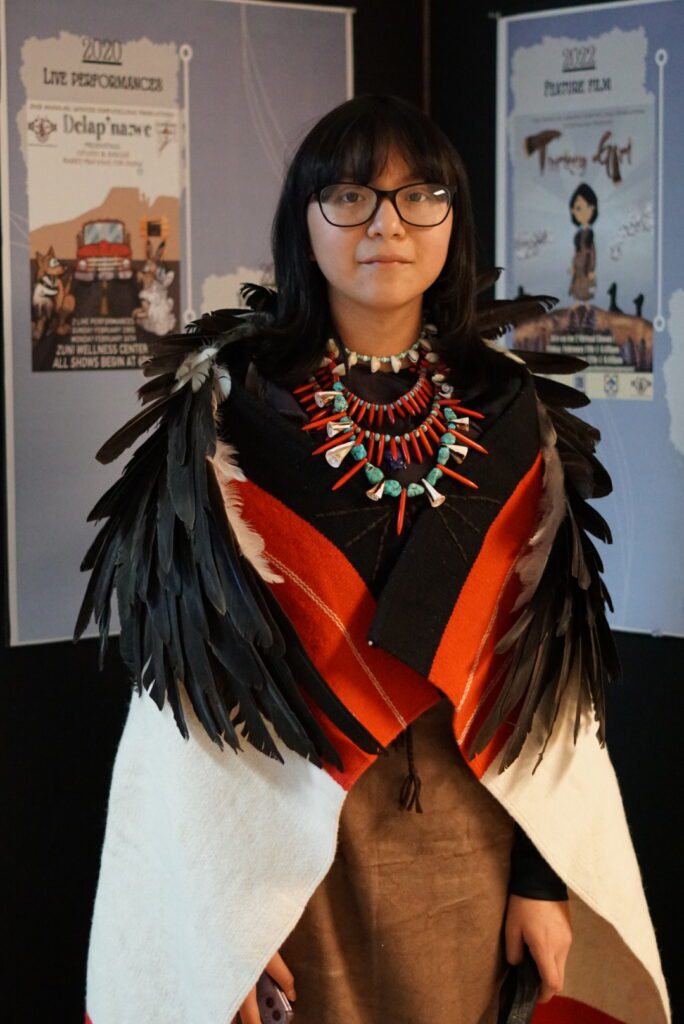
For 14-year-old Lyla Martinez, these performances have become a winter tradition — and an important part of growing up in Zuni. The ninth grader joined the program during its very first year, when she was just 6 years old.
“My mom and dad kept encouraging me and encouraging me,” Lyla says with a smile. “Eventually I gave in and joined.”
Her cousin Amelie Waseta, who is just a year older, signed up with her.
“People call us twins,” Lyla says. “We’ve done it together every year since then.”
Lyla’s mother, Carle Eustace, remembers attending the first informational meeting for the Delapna:we Project. Community members gathered as staff from ZYEP and the A:shiwi A:wan Museum & Heritage Center shared their vision.
“They wanted to bring Zuni stories back to life,” Carle says. “We heard them out.”
At the meeting, organizers invited youth to help create a promotional video encouraging families to sign up for the inaugural program.
“We had no idea what we were in for,” Carle remembers, laughing. “The kids didn’t either.”
Over the years, Lyla has grown alongside the program. She says her favorite year was 2024, when she performed in “Suski an Delapna:we (Coyote’s Tales).”
“I got one of the main roles, Silo,” she says, referring to the Zuni word for scaled quail. “I was nervous because I’d never had a big role like that. It was a big step. I had to memorize a lot of lines.”
This year, Lyla played Fancy Turkey Girl, while her cousin played Poor Turkey Girl. In this Zuni variant of the Cinderella story, a poor orphan girl is transformed for a sacred dance but forgets her promise to the turkeys who helped her.
While she enjoys the performances, Lyla says she appreciates the opportunity to practice and strengthen her language skills.
“I like the plays, but the most fun is getting better with my Zuni language,” she explains. “It makes me feel proud and more connected to Zuni culture.”
She also understands why the Delapna:we Project matters.
“People might not otherwise know these stories, or tell them anymore,” Lyla says. “Delapna:we is important because the stories are from a long time ago. Everyone works hard to keep them alive. To keep them going to the next generation and the next and the next.”
In addition to Delapna:we, Lyla was part of ZYEP’s youth soccer league for many years. She joined the league in third grade and participated until she aged out last year.
In general, she says she prefers creative pursuits, although she does like roller skating. She enjoys drawing, making crafts, writing fiction and playing the piano, which she has studied for five years. One day, she hopes to attend art school and pursue a career in the arts.
Carle says she is grateful that today’s youth have access to programs like Delapna:we.
“In my day, there were resources, but nothing like what we have now,” she says. “It’s important that the youth use them. It’s in their hands. I’m so happy we’re doing this.”
For Lyla, the program’s impact extends beyond language and performance. She says participating in plays like “Rabbit Praying for Snow” helped her form friendships with girls she might not have connected with otherwise.
“We’re still friends today,” she says, adding that the experience also has helped her grow personally.
“It’s made me less shy and more confident,” she explains. “There are so many people supporting me — a lot of people helping out, especially with language.”
For Lyla, and everyone else who shared the story of “Turkey Girl” this winter, Delapna:we is more than a performance. It’s a way to stay connected to culture and carry it forward.