
At Shiwi Ts’ana Elementary School’s Indigenous Day celebration this spring, a line of children
gathered near the singers, waiting for permission to join in. Some already knew the songs. Others
simply wanted to stand close to the drum, listening and learning alongside the adults leading the
music.
“They asked if they could sing with us during the dance,” Mangaysha Kallestewa remembers.
“We told them if their teachers said it was OK, they were welcome to. They’re talented kids.”
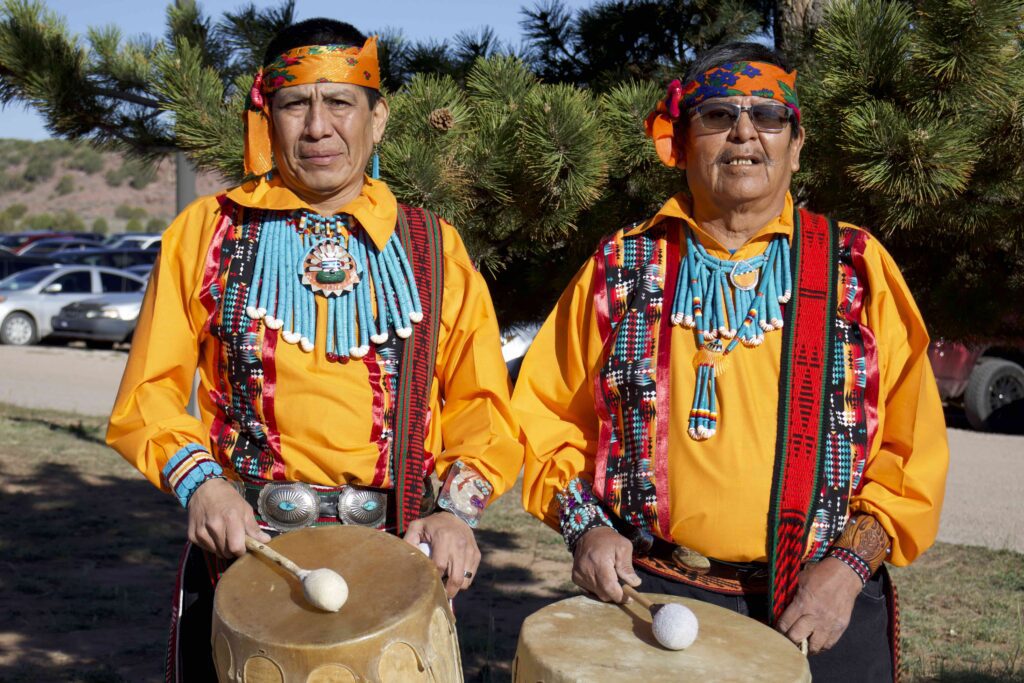
For years, Mangaysha Kallestewa and Cyrus Lutse have shared traditional songs and dances with
youth in the Pueblo of Zuni, frequently through the Zuni Youth Enrichment Project’s cultural
programming. Generations of children have grown up seeing them at community events and now
recognize them everywhere, from ZYEP’s Summer Camp and in-school cultural programs to
basketball games and the grocery store.
“The little pre-K kids always say, ‘We know you from Head Start,’” Mangaysha says with a
laugh. “And sometimes they call us ‘sinners’ instead of singers!”
Both men were born and raised in Zuni, and they say music and dance have been part of their
lives for as long as they can remember. Cyrus grew up traveling with his grandfather to
ceremonies in places like Flagstaff and Window Rock, Arizona.
“I went to school until ninth grade,” he says. “I was raised by my grandpa doing this. That’s how
I learned. He had a dance group, and we were the dancers.”
Cyrus also had opportunities to travel around the United States with a school dance group. He
says he visited New Jersey and California, stopping in Fresno and even Disneyland in Anaheim.
Mangaysha says his grandparents were a powerful influence as well. He grew up listening to
songs his grandfather (the late Conrad Blue of the Blue Dance Group) sang at home and
recordings his grandmother played for the family.
“I started hearing this music when I was a little baby,” Mangaysha says. “I grew up listening to it
and dancing around the house, just having fun.”
He began learning traditional Zuni dances as a pre-K student at Head Start, which hosted a
Native American Day. His dance education continued at St. Anthony’s School, where he
attended kindergarten through eighth grade and participated in the school’s Indian Days
celebration.
As he grew older and became involved in his Kiva membership, Mangaysha’s interest in singing
deepened. He planned to attend college after his high school graduation, but then he received an
invitation to join the internationally recognized Cellicion Zuni Dancers, also known as the
Traditional Zuni Dancers under the leadership of Fernando (Lasiloo) Cellicion.
Mangaysha spent nearly 20 years traveling with the group throughout the United States and
overseas. He also performed with the First Nations Dance Company under the late Richard
Donaghey, and those experiences took him across much of the United States and to countries
including Australia, Taiwan, Lithuania, Estonia, Mongolia, Ireland and the Netherlands.
“I was honored to share our culture and our dances,” he says. “I think my favorite place was
Mongolia. It felt similar to being on the reservation, and I had a great experience riding a camel.”
Watching other cultural groups perform during his travels helped shape his vision for the future.
Mangaysha says he had always wanted a dance group — and not just any dance group.
“I really wanted a youth dance group so our traditions and culture would continue,” he explains.
That vision came to life with ZYEP more than 15 years ago. Back then, the fledgling youth
project was operating Summer Camp out of the former Twin Buttes High School, but it would
expand its community programming and open its dedicated facility at Ho’n A:wan Park in the
years to come.
At the time, Mangaysha and Cyrus were active members of local dance groups, which they say
were once common in the pueblo. Their original number of eight or nine regular members
dwindled to four by the early 2010s, and now it’s just the two of them.
Yet their determination has never wavered. Today, they are steady cultural mentors for the Zuni
community, introducing hundreds of children to traditional songs, dances and cultural teachings.
“We do this to keep our traditions and culture going so they won’t be lost,” Mangaysha says.
“Our language too. It’s so valuable.”
Cyrus says the work helps prepare Zuni youth for the future. He wants them to have the
foundation he and Mangaysha received as children.
“It’s important for the kids to learn the traditional dances and also understand the difference
between religious and social dances,” he says. “When they grow up and get initiated, these songs
will already be in their heads. They’ll know the movements and learn quickly.”
In addition to teaching children about the meanings connected to dances and ceremonies, the pair
also talk with them about cultural values and showing respect. Tahlia Natachu-Eriacho, ZYEP’s
executive director, says the children absorb more than the adults might realize.
“One time during a ceremony, my phone rang and I pulled it out,” she recalls. “My son
immediately whispered, ‘We’re not supposed to have our phones out. Mr. Cyrus and Mr.
Mangaysha taught us that!’”
Cyrus says he loves teaching and spending time with the kids. He remembers one student on
crutches who insisted on dancing anyway.
“He was the first one really putting effort into it during practice,” he says.
“I remember that,” Natachu-Eriacho says. “He pushed himself so hard. When he got tired, he’d
lean on his crutches, rest and then jump right back in. His family was crying because they were
so proud of him.”
Moments like that stay with both Mangaysha and Cyrus. Although they have performed for
audiences across the country and around the world, they say working with children has become
one of the most meaningful parts of what they do.
“I always enjoy working with the kids and listening to their stories,” Mangaysha says.
They are encouraged by what they see in younger generations. Natachu-Eriacho shares that some
middle school students are already talking about forming their own singing and dance groups.
“When I was growing up, kids got made fun of for singing and dancing, so a lot of people
stopped,” she says. “Now the kids seem really proud of it.”
Cyrus says he hopes they continue, advising, “Just keep it up. Keep going. No matter what
people say or if they try to put you down, keep it in your heart. Make other people feel good
through dancing and singing. People come to dances and songs to feel better.”