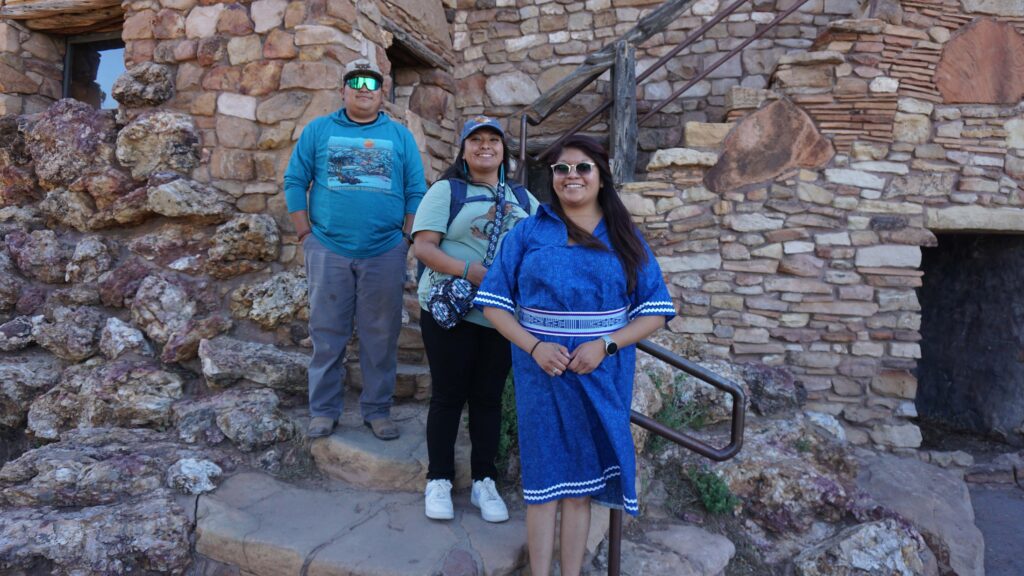

ZUNI, N.M. (May 28, 2026) — For three days at the Desert View Watchtower, visitors gathered around tables filled with Zuni art as three young artists explained their work and carefully wrapped pieces that would soon travel home with people from across the country and around the world. By the final day, a surprising number of the items they showcased in the Grand Canyon Cultural Demonstration Program had sold.
For Vanicka Neha, Tiyana Haloo and Joseph Lucio, the May 11-16 trip to Grand Canyon National Park marked the culmination of the Zuni Youth Enrichment Project’s six-month Advanced Artist Apprenticeship, an intensive professional development program for the top students from ZYEP’s Emerging Artist Apprenticeship cohorts. Made possible with the support of the Bezos Family Foundation, the current program began Nov. 17, 2025 and wrapped up the week of May 18.
Neha, 24, focused on Pueblo embroidery. Haloo, 24, specialized in painting and 2D art, and Lucio, 24, concentrated on Pueblo pottery. And this was their first visit to the Grand Canyon, a landscape of deep cultural significance that includes the Zuni people’s sacred place of emergence.
“It was an eye-opener for them to see the terrain,” said Elroy Natachu Jr., ZYEP’s art coordinator.
During their stay, the three advanced apprentices participated in three demo days at the Desert View Watchtower, sharing their artwork and engaging with visitors as cultural ambassadors. Natachu and Kandis Quam, ZYEP arts leader, accompanied the group as instructors, mentors and cultural advisors.
Unlike the Emerging Artist Apprentices’ cultural demonstration experience earlier this spring, which coincided with spring break for much of the country, this one struck a balance that allowed the artists to settle into the rhythm of each day.
“It was busy but bearable,” Natachu said with a laugh. “It wasn’t as overwhelming as our spring trip.”
Visitors stopped to ask questions about materials, techniques and cultural significance while the young artists managed sales, discussed their creative processes and adapted to the pace of a real-world public setting. According to Natachu, they rose to the challenge, putting months of training into practice.
“This is what we prepped them for,” he said. “Customer service, business practices, how to price their work — and also how to take care of themselves. The wellness aspect is important too. Being an independent artist can be taxing, and we want to help them develop businesses they can thrive in.”
“During the Advanced Artist Apprenticeship, I appreciated the chance to learn a new medium and techniques from one of the few textile artists we have within the community,” Neha said. “Alongside learning the symbolism of each color and pattern, I also was gaining knowledge of the art business. It has given me more insight into marketing, commissions, the value and pricing of each piece, and a realistic view of living as an artist.”
Grand Canyon visitors responded enthusiastically to the apprentices’ work throughout the three-day demonstration program. Haloo said her favorite part of the trip was meeting so many friendly tourists, some of whom came from as far away as the United Kingdom and South Korea.
“They asked questions about ZYEP and the art we do,” she said. “It was exciting, getting to know where people were visiting from — and then selling one of my favorite paintings to a woman from Texas!”
Haloo displayed the largest number of pieces, which included paintings, prints, stickers and magnets. Lucio brought pottery ranging from smaller functional items to larger vessels, while Neha focused on a more limited number of elaborate, time-consuming embroidered items.
“Vanicka wasn’t too surprised by the number of pieces she sold,” Natachu said. “She had sewn embroidered panels onto shirts, and she knew those would likely sell. But the others were surprised!”
Lucio’s pottery sales exceeded his expectations, particularly because larger ceramic pieces can be difficult for buyers to transport home safely. Haloo definitely was surprised to sell one of her larger paintings, and Natachu observed this was a milestone for her as an artist.
“Someone really wanted to have a piece of her work,” he said.
After the hectic pace of the three demonstration days, the three apprentices were ready to enjoy Grand Canyon National Park. Their itinerary included a full “park day” on May 15, and the group spent it exploring trails, scenic overlooks and visitor sites along the South Rim.
At the visitor center, they watched two documentary films, an older one dedicated to the canyon’s geology and a newer one focused on the tribal nations connected to the canyon. It has been home to 11 tribes for generations: Havasupai, Hualapai, Hopi, Yavapai-Apache, Kaibab band of Southern Paiute, Las Vegas band of Southern Paiute, Moapa band of Southern Paiute, Paiute Indian Tribes of Utah, San Juan Southern Paiute Tribe, and Zuni.
“That film provided the Indigenous perspective,” Natachu said. “It explored the tribes’ cultural ties to the canyon.”
Not only did the students have an opportunity to see photos and video footage of the Zuni people’s place of emergence, they learned more about other nations’ emergence and creation stories and the different types of ancestral art. They also spent time with Grand Canyon National Park Ranger Dan Pawlak.
Pawlak, who leads the Grand Canyon Cultural Demonstration Program, introduced the young artists to professional opportunities connected to Indigenous arts and cultures. He also shared information about the many types of employment with the National Park Service, from desk jobs to positions that could take them all along the rims and even deep into the canyon itself.
“They learned so much they hadn’t known before,” Natachu said.
Now that the apprenticeship has concluded, all three artists plan to continue developing and sharing their work. Lucio is completing his post-secondary education while exploring both pottery and textiles, and Neha is pursuing her embroidery, beadwork and textile practice while taking custom orders.
“What I would like to do with my art in the future is give back to my community,” Neha said. “It would be a good opportunity to help support any upcoming artists pursuing textile work.”
Haloo hopes to participate in art markets and expand her visibility. She also is looking forward to sharing knowledge with the next generation.
“I want to pass down the art skills that I learned from all the previous apprenticeships to my son, and see what he decides to create,” she said.
Meanwhile, at ZYEP, a new cohort of Emerging Artist Apprentices has started their journey. The 10-week apprenticeship, focused on Pueblo sewing, began May 26.
To learn more about the Zuni Youth Enrichment Project and its programs, and for information about making donations, partnering with ZYEP, and volunteering, call (505) 782-8000 or visit zyep.org. And, to stay up to date on the latest news and events, follow the nonprofit youth organization on Facebook (/zuniyouthenrichmentproject), Instagram (@zuniyouthenrichmentproject), YouTube (/ZuniYouth), and TikTok (/zyep09).
Founded in 2009, the nonprofit Zuni Youth Enrichment Project is dedicated to promoting resilience among Zuni youth so they will grow into strong, healthy adults who are connected with Zuni traditions. ZYEP fulfills its mission by providing positive role models, enriching programs, and nurturing spaces that contribute to the healthy development of Zuni youth. ZYEP strives to provide every child with the encouragement and opportunities they need to reach their full potential.