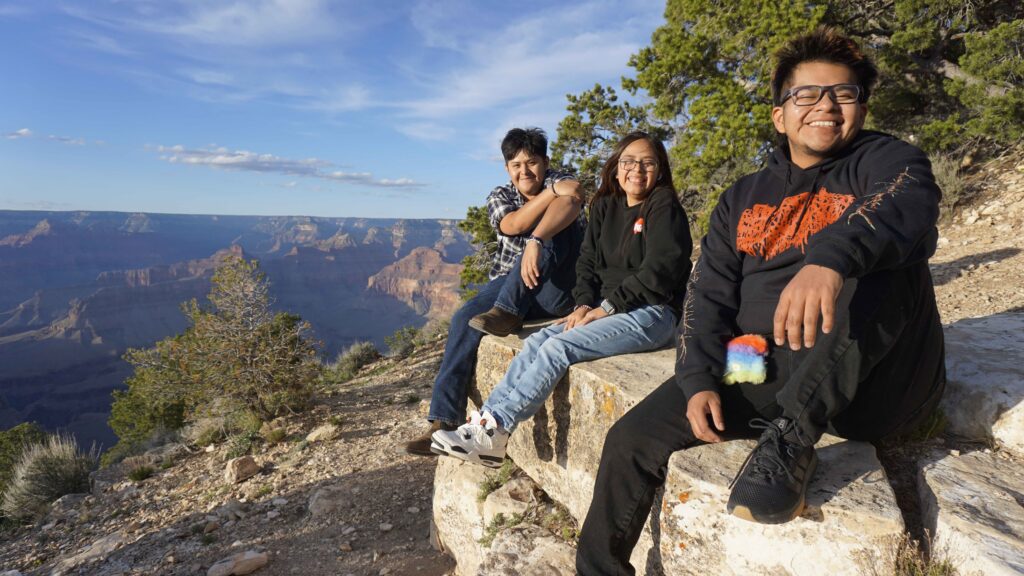

ZUNI, N.M. (April 22, 2026) — By midmorning at the Desert View Watchtower, the demonstration area was already crowded. Visitors leaned in to watch as Kaleb Leekity, Maliyah Halusewa and Jerone Shelendewa worked their looms, weaving hair ties and sash belts while answering a steady stream of questions.
Some visitors asked about the designs. Others wanted to know how long each piece took, and many were seeing Pueblo weaving up close for the first time. The young artists were nervous at first, but by the end of the first day, they were leading the conversations.
The Zuni Youth Enrichment Project’s spring trip to the Grand Canyon Cultural Demonstration Program on March 31 to April 3 marked an important milestone for these young people, all of whom were top students in ZYEP’s recent Emerging Artist Apprenticeship in Pueblo weaving. Through the 10-week program, students learned foundational techniques, strengthened their skills, and deepened their understanding of the cultural significance of the art form.
Art Coordinator Elroy Natachu Jr. and Art Leader Kandis Quam accompanied the group, guiding them through two days of public demonstrations at one of Grand Canyon National Park’s most visited cultural sites.
“It was a really fun experience,” Natachu said. “It was surprising to see how busy it got. Apparently it was spring break on the East Coast, and for Kandis and I, it was the busiest it’s ever been for us, working as artists ourselves or as mentors.”
That level of activity created both pressure and opportunity for the apprentices, who were navigating not only their craft but also how to represent it. Although the attention often felt overwhelming, they rose to it.
“We gave them a lot of our tips and tricks,” Natachu said. “Keep your positivity and professionalism, give out good energy, and focus on customer service. You are ambassadors for your community. Tourists come from all over, and they might not ever meet another Zuni person in their lifetimes.”
For Leekity, 25, this was a meaningful experience, both personally and professionally.
“I’ve always dreamed of doing what Elroy and Kandis do, promoting and representing home,” he said. “I learned about engaging with the public, getting to know about the job offers the Grand Canyon has—it’s on my mind to go back. The hardest part was not being shy with the public or stuttering my words, but I loved the experience to the fullest.”
Halusewa, 18, said the cultural demonstrations pushed her to deepen her understanding of her own work.
“You will be asked a lot of questions, and you have to be detailed when explaining what the designs are, the meaning of the belts, and what they are being used for,” she said. “The most rewarding aspect of the demonstration process is being able to show what I learned in 10 weeks of the apprenticeship program and being able to carry on our tradition.”
The apprentices rotated between smaller items such as keychains and hair ties and larger loom work while also managing sales and interacting with visitors throughout the day. According to Natachu, the customers responded with enthusiasm.
“They told the students how proud they were of them for their patience and tenacity,” he said. “It can be difficult for us, because we’re taught to be humble, but we can be proactive with our art. We teach the youth how to share their journey and development as artists.”
That growth was visible over the course of the apprenticeship program. Natachu noted that he and Quam saw a huge shift from day one at Ho’n A:wan Park in Zuni to the demonstration days at the Grand Canyon.
“It’s a whole new maturity level, and it’s fun to see the young people take the reins,” he said.
Halusewa said interacting with the public was initially challenging, but she stepped outside her comfort zone and got through it. Shelendewa, 18, said he felt pressure in the beginning, but the payoff was worth it.
“The most rewarding things about the trip were having fun and learning more about the history of Zuni,” he said.
An itinerary adjustment championed by Park Ranger Dan Pawlak and Interpretive Ranger Kelli Jones allowed the students to conduct demonstrations for two days instead of three, giving them one free day to enjoy the national park. They met with National Park Service staff, including Superintendent Ed Keable, and learned about the park’s ongoing efforts to collaborate with tribal nations on cultural preservation and interpretation.
In addition, the apprentices connected with Native professionals working in fields such as firefighting and archaeology, gaining insight into potential career paths that connect cultural knowledge and land stewardship.
“It was eye-opening for them to see the opportunities available,” Natachu said. “You just have to go out and get them.”
The three-night trip also included time for shopping, recreation and simply processing everything they’d learned about their art and their place within a larger cultural and professional landscape. And for Natachu and Quam, it was an opportunity to deepen relationships outside of the classroom.
“This was a good time to talk and bond with them,” Natachu said. “I got to know them as individuals, on a personal level, not just as students. I learned who they are, and what they want to do with art and in their lives.”
The Grand Canyon has been home to 11 tribes for generations: Havasupai, Hualapai, Hopi, Yavapai-Apache, Kaibab band of Southern Paiute, Las Vegas band of Southern Paiute, Moapa band of Southern Paiute, Paiute Indian Tribes of Utah, San Juan Southern Paiute Tribe, and Zuni. And the Grand Canyon Cultural Demonstration Program continues to provide opportunities for Native artists to share their work in a setting that reaches visitors from around the world.
At ZYEP, that work continues: The next Emerging Artist Apprenticeship, focused on Pueblo sewing, opened for registration on Apr. 20 and is expected to fill quickly. The program begins May 26.
To learn more about the Zuni Youth Enrichment Project and its programs, and for information about making donations, partnering with ZYEP, and volunteering, call (505) 782-8000 or visit zyep.org. For updates, follow the nonprofit youth organization on Facebook, Instagram, YouTube and TikTok.
Founded in 2009, the nonprofit Zuni Youth Enrichment Project is dedicated to promoting resilience among Zuni youth so they will grow into strong, healthy adults who are connected with Zuni traditions. ZYEP fulfills its mission by providing positive role models, enriching programs, and nurturing spaces that contribute to the healthy development of Zuni youth. ZYEP strives to provide every child with the encouragement and opportunities they need to reach their full potential.