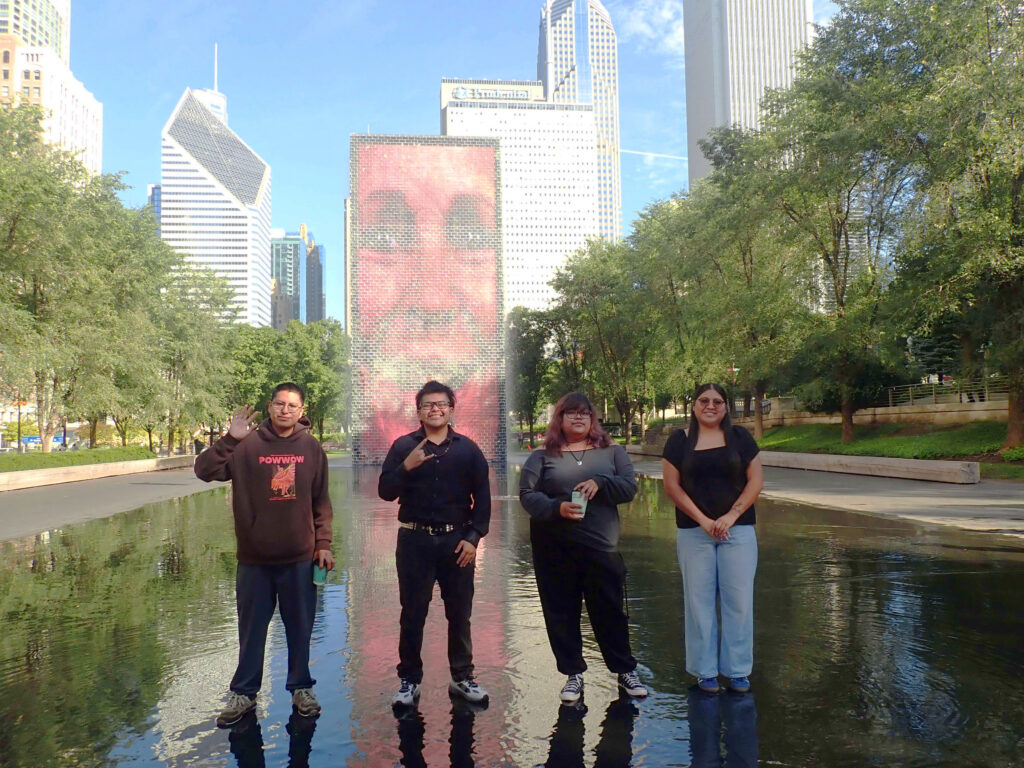

ZUNI, N.M. (Oct. 21, 2026) — Four young Zuni artists traveled to Chicago this fall for several days of museums, galleries, cultural institutions and city exploration. Along the way, they gained a firsthand look at how Native artists and professionals are creating space for Indigenous voices far beyond the Southwest.
Made possible with support from the Bezos Family Foundation, the Zuni Youth Enrichment Project’s Sept. 28-Oct. 2 educational arts trip brought together participants from several of its Emerging and Advanced Artist Apprenticeship programs. ZYEP Arts Leader Kandis Quam said staff selected young people who have shown a deep interest in taking their artwork and voice to new levels, becoming Zuni advocates through art.
The group included Kaleb Leekity, 25, a 2026 Pueblo weaving apprentice; Breydon Othole, 24, a longtime ZYEP arts participant who has completed multiple apprenticeships and served as a 2D painting/graphic arts instructor; Kiley Gia, 21, a Pueblo embroidery apprentice; and Lacey Longhat, 20, who participated in ZYEP’s watercolor and 2D painting/graphic arts apprenticeships. Quam and ZYEP Operations Manager Josh Kudrna accompanied the young artists as chaperones.
For ZYEP, choosing Chicago was intentional. Staff wanted the young artists to experience a large city far from Zuni while learning to navigate unfamiliar surroundings with the support of trusted adults.
“It’s a good way for our youth to experience the world,” Quam said. “To experience culture shock with the support they need to navigate it. We told them our own stories about how we felt when we went through something similar when we were their ages.”
Kudrna agreed, noting that there is real power in traveling to the unknown and having the opportunity to see life from different perspectives.
“If we want to uplift the young members of the community to find their voices and understand the impacts they can have, opportunities like this trip are priceless,” he said. “It was a real treat to see our young artists soak up every moment. The time, effort and intention in getting them out there was undeniably worth it.”
Throughout the trip, the young artists met Native artists, museum curators and other professionals who shared insights about their work. They also showed the youth how Native people can build lives and careers in urban environments while remaining connected to their cultures and home communities.
“Our youth learned you can do both, and that really opened their eyes,” Quam said. “There are different ways to advocate for our people.”
One of the trip’s highlights was the Center for Native Futures, a Chicago-based arts organization dedicated to Native artists. There, the ZYEP group met Debra Yepa-Pappan, a Jemez Pueblo/Korean visual artist who co-founded the center and serves as its director of exhibitions and programs.
Quam said Yepa-Pappan and her staff introduced the visitors to the center and connected them with other artists. For Leekity, the visit revealed possibilities and resources he had not known existed.
“Debra and her staff were very welcoming,” he said. “I loved networking with the people we met.”
The group also traveled outside downtown Chicago to visit the Trickster Cultural Center in Schaumburg and the Gichigamiin Indigenous Nations Museum in Evanston. At Gichigamiin, the Center for Native Futures helped arrange an early visit that provided a preview of new exhibits and a guided tour.
Those visits were particularly meaningful for Leekity and Longhat, who are interested in museum careers. Quam said the young artists learned how Native professionals are improving the representation of Indigenous peoples and histories, as well as the care of cultural belongings.
Longhat said those conversations made a possible career feel more tangible.
“It really opened my mind to what goes on behind the scenes and what I can do to bring the knowledge to our community,” she said. “I want people to understand and see the actual history told from a Native American perspective.”
At the Art Institute of Chicago, the young artists viewed collections related to Zuni and the Southwest. Leekity reflected on what it meant to see Zuni pottery and jewelry so far from home.
“This was a once-in-a-lifetime experience,” he said. “I loved the atmosphere of the working city. I felt emotional reconnecting to our Zuni pottery artifacts and jewelry at the Art Institute of Chicago.”
Beyond the museums and Native cultural institutions, the young artists and chaperones explored Chinatown, took a boat ride on the Chicago River, studied the city’s varied architecture and fell in love with the city’s train system. They also visited Color Factory Chicago, an immersive art experience that offered a different approach to color than their apprenticeship work at home.
Lake Michigan made a particularly strong impression. Quam recalled the young artists staring in amazement and saying, “That’s a lake?”
Gia said the breadth of the experience exposed her to things she otherwise might never have encountered.
“I am very grateful to have had the honor and opportunity to attend the arts educational field trip to Chicago,” she said. “I was able to visit different museums, explore different parts of the city, and learn more about Native voices, art and culture outside of New Mexico.”
For Longhat, simply being there carried its own significance.
“My goal for this trip was to meet people and build connections outside the Southwest and, of course, to have fun and see all the things this opportunity can offer,” she said. “I can say the goal was met. I got to make those connections, I saw those bright city lights, and most importantly, I had fun.
“From being a rez kid on the reservation to flying in a plane to go see the city was something I wouldn’t have imagined,” she continued.
Heavy rain complicated the group’s final days in Chicago, and travel disruptions left them stranded overnight at Dallas Fort Worth International Airport. Quam said she and Kudrna reminded the young travelers that unexpected complications are part of traveling, and that learning how to respond to them is valuable, too.
“We told them, ‘It’s not convenient or fun, but you’re not alone,’” she said.
For Leekity, even the rain took on meaning. He said he viewed the heavy rainfall on their final night in Chicago as a sign that their ancestors had blessed the journey and remained with them.
“Seeing different kinds of art from all over the world gives me a huge perspective that anything is possible to achieve in the big city, especially for Native artists,” he said.
Gia said she was particularly grateful that ZYEP creates opportunities for young people to venture beyond familiar surroundings and then bring their experiences home.
“I truly appreciate their efforts in helping us get out into the world, experience new things, and bring what we learn back home,” she said. “Elahkwa!”
To learn more about the Zuni Youth Enrichment Project and its programs, and for information about making donations, partnering with ZYEP, and volunteering, call (505) 782-8000 or visit zyep.org. To stay up to date on the latest news and events, follow the nonprofit youth organization on Facebook (/zuniyouthenrichmentproject), Instagram (@zuniyouthenrichmentproject), YouTube (/ZuniYouth), and TikTok (/zyep09).
Founded in 2009, the nonprofit Zuni Youth Enrichment Project is dedicated to promoting resilience among Zuni youth so they will grow into strong, healthy adults who are connected with Zuni traditions. ZYEP fulfills its mission by providing positive role models, enriching programs, and nurturing spaces that contribute to the healthy development of Zuni youth. ZYEP strives to provide every child with the encouragement and opportunities they need to reach their full potential.