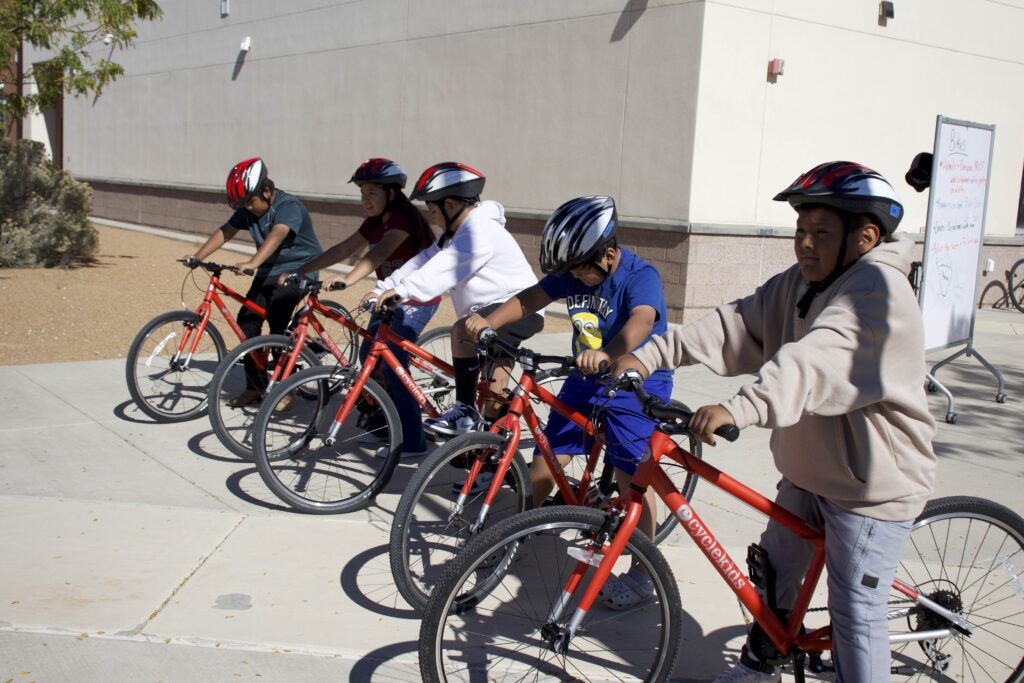
ZUNI, N.M. (Nov. 24, 2026) — Twenty-two students at Shiwi Ts’ana Elementary School learned to ride bicycles this fall, thanks to a monthlong physical education unit that brought the Zuni Youth Enrichment Project into the classroom. ZYEP staff helped young riders develop their skills, overcome challenges and discover the joy of bicycling.
Held Oct. 5-29, the unit reached approximately 220 students in fourth through sixth grades. ZYEP’s participation was supported by the New Mexico Department of Health’s Healthy Kids Healthy Communities program.
Physical education teacher Shanell Leekya has offered bicycling instruction at the school for four years, and she said this new partnership with ZYEP allowed her to devote more individual attention to beginning riders.
“The highlight this year was the collaboration,” Leekya said. “Ms. Rani worked with our advanced riders with games that were provided by another collaboration with Little Bellas. I was able to focus a little more on students who are still learning to ride.”
For ZYEP Youth Development Leader Rani Yamutewa, the experience was a valuable opportunity to connect with students.
“Biking at STE was tiring but so much fun,” she said. “I loved interacting and joking with the kids. I witnessed their fears and frustrations fade as we progressed through the weeks.”
Before the unit began, Yamutewa joined Leekya and ZYEP Program Manager Tara Wolfe for an Oct. 2 training session with Little Bellas, an organization that promotes bicycling opportunities for girls. The training introduced games and activities designed to help young riders practice balance, control their speed and navigate different terrain.
Yamutewa took the lead on those activities, with support from ZYEP Food Sovereignty Leader DeVon Bowekaty. Students played bicycle versions of familiar games such as Red Light, Green Light, along with Pool Noodle Limbo and Safety Officer.
Fifth-grader Braiden R., an experienced rider, particularly enjoyed the Safety Officer game. Yamutewa rode around on her bicycle, watching for students who were going too fast; anyone she caught speeding received a tap with a pool noodle and had to park their bicycle to complete five jumping jacks.
The games gave experienced riders opportunities to challenge themselves while reinforcing safe riding habits. For students still learning, the month brought a different set of challenges and some memorable breakthroughs.
Fifth-grader Nicole E. described the experience as “mid,” explaining that it was both good and bad because learning to ride wasn’t easy.
“I was always almost crashing into others, but the good part is I can ride a bike now,” she said.
Classmate Zayden C., who was experiencing the bicycling unit for the first time, said Leekya’s approach helped him gain confidence. In particular, practicing pedaling with one leg helped him progress toward riding independently.
Yamutewa said one of her favorite moments came when two experienced fourth-grade riders decided to stop riding on their own and help a classmate who was still learning. They parked their bicycles, held his handlebars and helped him practice.
“Ahh man, the joy we all shared in that moment is engraved,” she recalled.
Other lessons came through trial and error. During one sixth-grade class, Yamutewa challenged students to make a wide turn without putting a foot down for balance. Several repeatedly rode into a shrub along the road, emerging with leaves on their clothing but laughing and trying again.
“As they practiced, a lot of our students came to understand the concept of resilience,” she said. “After they crashed their bikes, they got back up and pushed through the frustrations they had.”
By the end of the unit, 22 students had learned to ride, and more than 10 others were close to mastering the skill. In student feedback, 87% said bicycling was fun, and 80% reported feeling confident riding a bicycle after the unit.
Leekya captured videos of students learning to ride and shared them with their families. Parents responded with pride and appreciation, including one who told her, “Now we can take their bike out of the shed, and they can ride at home.”
The experience also highlighted a broader challenge for Zuni youth. Although 62% of students reported having a bicycle at home, that figure included bicycles that were not in working condition. Yamutewa said more access to bicycles and repair services would help children continue practicing outside school.
“I feel like the youth in our community need more access to bikes, or a system to support bicycle repairs,” she said. “A majority of the kids enjoy it, but if they don’t have bikes — or working bikes — at home, the only time they get to ride will be in PE with Ms. Shanell.”
To learn more about the Zuni Youth Enrichment Project and its programs, and for information about making donations, partnering with ZYEP, and volunteering, call (505) 782-8000 or visit zyep.org. To stay up to date on the latest news and events, follow the nonprofit youth organization on Facebook (/zuniyouthenrichmentproject), Instagram (@zuniyouthenrichmentproject), YouTube (/ZuniYouth), and TikTok (/zyep09).
Founded in 2009, the nonprofit Zuni Youth Enrichment Project is dedicated to promoting resilience among Zuni youth so they will grow into strong, healthy adults who are connected with Zuni traditions. ZYEP fulfills its mission by providing positive role models, enriching programs, and nurturing spaces that contribute to the healthy development of Zuni youth. ZYEP strives to provide every child with the encouragement and opportunities they need to reach their full potential.