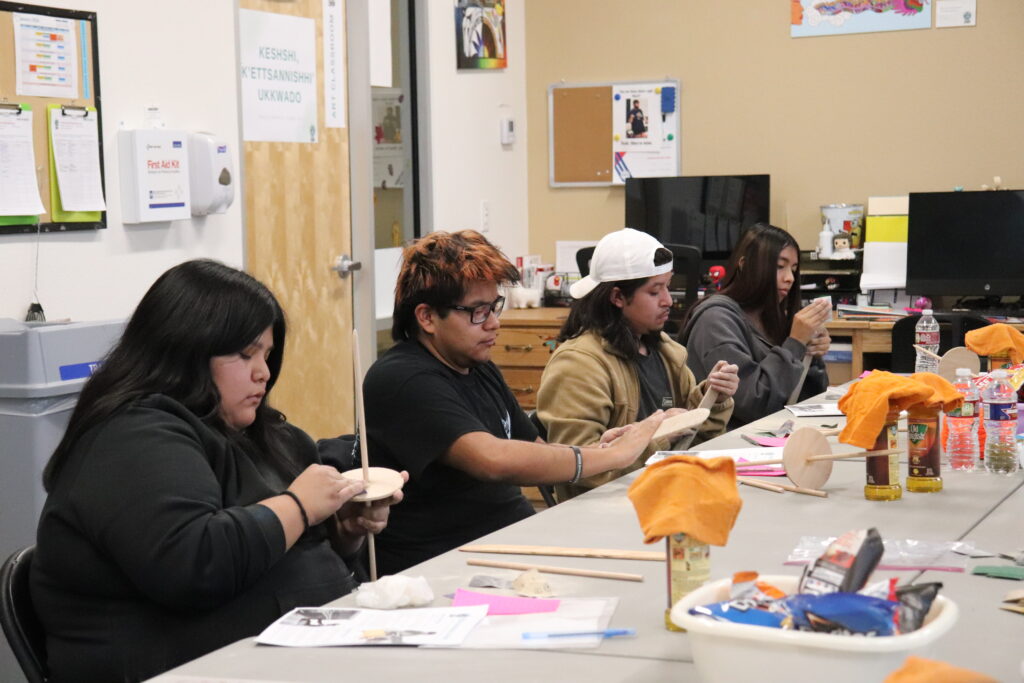

ZUNI, N.M. (Jan. 26, 2026) — This month, the Zuni Youth Enrichment Project welcomed 12 new art students ages 15 to 24 to its first Emerging Artist Apprenticeship of 2026. The students are studying Pueblo weaving with instructors Elroy Natachu Jr., ZYEP’s arts coordinator, and Chasady Simplicio, a graduate of ZYEP’s Emerging and Advanced Artist Apprenticeship programs.
Made possible with support from the Bezos Family Foundation, Ancestral Rich Treasures of Zuni (ARTZ) Cooperative and First Nations Development Institute, the 10-week apprenticeship kicked off Jan. 20. It will conclude with a public showcase at 5-7:30 p.m. on March 27 at Ho’n A:wan Park.
Prior to the official program start, students participated in a series of preparatory sessions designed to build community, connect them with local resources, and get them ready for the apprenticeship.
They arrived eager and ready to dive into the prep work. In their intake surveys, students described motivations that ranged from reconnecting with ancestral traditions and supporting cultural needs in their families and community, to exploring a new art form, expressing creativity, and building skills they hope to carry forward beyond the apprenticeship.
“I want to learn for myself to share the teachings of weaving with my peers and younger generations,” said Virginia “Gina” Sanchez, 23. “It’s hard to find weavers to buy from, or it can be too pricey, or people simply don’t have the money.”
The first session was a ZYEP meet-and-greet on Wednesday, Jan. 14 at Ho’n A:wan Park, which gave students and their family members an opportunity to get to know the instructors and one another. Natachu said many of them were meeting Simplicio for the first time, and he reflected on the significance of having a student return to the youth project as a teacher.
“The stars and moons aligned,” he said. “It’s so cool to have Chasady on the instructor side, after watching them go through both apprenticeships and the Grand Canyon Cultural Demonstration Program. They’ve really found themselves as a Pueblo weaver—they’re thriving.”
Now teaching alongside their former mentor, Simplicio said they hope students gain a deeper understanding of weaving as a tradition as well as an art form.
“I hope they learn not just the art of weaving, but also the history, meanings and cultural significance these pieces hold,” Simplicio said. “I want them to understand it all, so we don’t lose this art form’s roots and importance.”
On Thursday, Jan. 15, ZYEP accompanied the students to the ARTZ Cooperative and A:shiwi College and Career Readiness Center. The visits introduced them to arts resources, equipment and facilities available within the community.
“On Friday we walked them through apprenticeship basics and what to expect as far as the showcase is concerned,” Natachu said. “We started the apprenticeship on Jan. 19 with a week dedicated to the history of Pueblo weaving. It’ll be interesting to see how they absorb it.”
During this time, the instructors also assessed the students’ basic knowledge of weaving. Most of the group are new to the art form, although a few were exposed to it at Zuni High School.
“We’re also paying close attention to how everyone’s learning styles might be similar or different,” Natachu noted.
The students will be learning plain weave and double float weave as they create keychains, hair ties, leg ties and belts. They’ll also learn about traditional colors, dyes and fiber types.
“I want to relearn how to make a belt and spin yarn so I can make belts for family members for cultural practices,” said Kaleb Leekity, 24. “And pass that knowledge down to my little brother and nephews.”
Traditionally, Ancestral Pueblo people used yucca fiber in their weaving. Cotton arrived between 100 and 900 A.D., obtained through trade with Meso-American tribes, and was prized due to its semblance to clouds and life-giving moisture.
“That’s when we started the sash-belt weaving that we know today,” Natachu said. “We incorporated our traditional patterns and designs. It’s important that our students understand not only where we came from and who we’re honoring, but also the role of the trade systems.”
Cotton became harder to cultivate as the climate changed. When Spanish and other European missionaries arrived in the Southwest with their livestock, including sheep, they introduced the Zuni to wool—and the people embraced it.
“It was comfortable, and it was warm in winter,” Natachu said. “But, like cotton, wool is temperamental to work with, so our students will be using acrylic yarn instead.”
Acrylic yarn is affordable, and it’s easy to find at craft stores. It’s also stretchy, which makes it a user-friendly choice for beginners.
While the students won’t be dyeing the yarn themselves, they will learn to spin and set the yarn.
“It’s really cool to see them go through the steps,” Natachu said. “In our earlier apprenticeships, we incorporated some pre-made things. Not this time!”
Not only has the weaving apprenticeship been expanded from seven weeks to 10 weeks, ZYEP’s art team also has been working closely with Simplicio to evolve the program’s structure.
“Because Chasady has been through multiple ZYEP programs as an art student, it was great to do some brainstorming,” Natachu said. “We’ve made the program even stronger.”
To learn more about the Zuni Youth Enrichment Project and its programs, and for information about making donations, partnering with ZYEP, and volunteering, call (505) 782-8000 or visit zyep.org. And, to stay up to date on the latest news and events, follow the nonprofit youth organization on Facebook (/zuniyouthenrichmentproject), Instagram (@zuniyouthenrichmentproject), YouTube (/ZuniYouth), and TikTok (/zyep09).
Founded in 2009, the nonprofit Zuni Youth Enrichment Project is dedicated to promoting resilience among Zuni youth so they will grow into strong, healthy adults who are connected with Zuni traditions. ZYEP fulfills its mission by providing positive role models, enriching programs, and nurturing spaces that contribute to the healthy development of Zuni youth. ZYEP strives to provide every child with the encouragement and opportunities they need to reach their full potential.