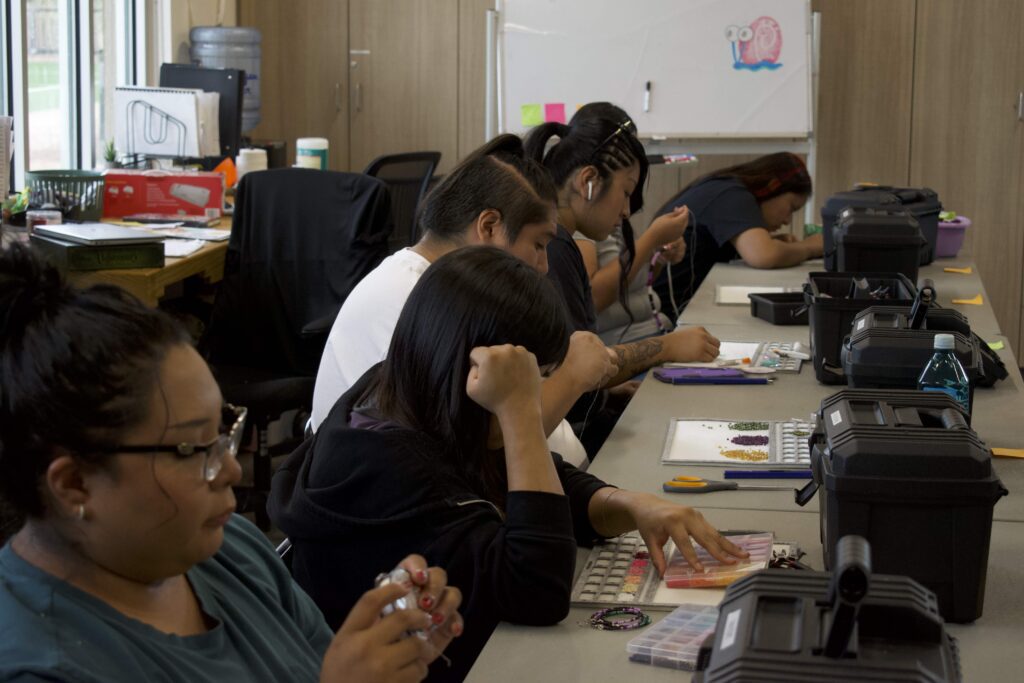

ZUNI, N.M. (Sept. 17, 2026) — Eleven young artists ages 13 to 24 are learning the art of beadwork this fall through the Zuni Youth Enrichment Project’s Emerging Artist Apprenticeship. Made possible with support from the Bezos Family Foundation and First Nations Development Institute, the apprenticeship will culminate in a public showcase at Ho’n A:wan Park on Friday, Oct. 23, from 5 to 7:30 p.m.
The 10-week program, led by co-instructors Vanicka Neha and Aidan Banteah-Yuselew, introduces students to beadwork techniques, history and cultural knowledge as well as the practical skills involved in developing inventory and selling their work. Most of the 11 apprentices are new to ZYEP’s art apprenticeships, with only Jensen Homer, 19, and Taylor Shack, 15, returning.
The students’ beadwork background varies widely. ZYEP Arts Coordinator Elroy Natachu Jr. said some arrived with years of experience, while others had worked primarily with pony beads or friendship bracelets.
The apprenticeship began by exploring the history of beadwork across Native North America. Ancestral peoples created beads from natural materials long before Europeans introduced manufactured glass seed beads through trade in the 1600s; later, Native artists incorporated the new materials into existing artistic traditions, much as Pueblo communities adapted to the wool yarn and metal needles introduced by the Spanish.
“The new materials didn’t replace the old art form, but enhanced it,” Natachu said, noting that glass beads offered artists a wider range of colors than natural pigments could provide.
As beads moved along trade routes, Native communities incorporated them into their own distinctive art forms. At Zuni, artists used beads in items such as ankle bands, armbands and cornmeal pouches, and techniques such as peyote stitch allowed them to create detailed effigies.
Today, loom beading is predominant at Zuni, Natachu said. The Emerging Artist Apprentices are learning peyote, whip, lazy and appliqué stitches, including techniques used for medallions and pendants that Neha and Banteah-Yuselew incorporate into their own work.
For Neha, teaching represents a new chapter in an art form she first learned by watching her grandmother.
“I have been beading for about 11 years,” she said. “Observing my grandmother working with her loom sparked an interest inside me. I started loom work with her guidance.”
Over time, Neha expanded into medallions, lanyards and earrings, eventually combining quillwork with beadwork. She never imagined herself becoming an instructor.
“This is my first time teaching, and from the start of the apprenticeship, I was feeling excited and nervous about teaching others this art form,” she said. “Seeing their confidence grow as they continue to express themselves in their own creativity is the best and most exciting part of teaching.”
Banteah-Yuselew came to beadwork through a very different route. He began six years ago, learning through YouTube during the Covid-19 pandemic. He said he enjoys seeing how each apprentice approaches a lesson differently and watching “the positive effects I have on the students.”
The instructors eased the group into the art form with memory wire and size 8/0 seed beads, which are easier for beginners to handle. Students made wrap bracelets and dangle or hoop earrings, small projects that allowed them to experiment with color and design while learning how smaller, accessible pieces can help build inventory.
There was a physical learning curve, according to Natachu.
“I’d see them trying to catch their beads with the needle, and some would go flying,” he remembered with a laugh. “They got better as their hand-eye coordination and dexterity improved.”
The students’ first major project involved using cord and a wrapping technique to create lanyards, wristlets and keychains. This week, they moved into appliqué work, which will allow them to create earrings, medallions and pins.
“I’m loving this apprenticeship so far,” said Makaya Chavez, 20, who already had experience with loom beading, armbands, ankle bands and cornmeal pouches. “It eases my mind and gives me something to do, and I love beading, so that’s a plus.”
Tavia Etsate, 24, entered the apprenticeship with only entry-level experience making friendship bracelets. With her wristlet project now behind her, she described the class simply: “It keeps my mind clear.”
That sense of calm has become noticeable throughout the classroom, Natachu said. Students increasingly talk with one another and lean on their peers for help, but when everyone settles into their work, the room becomes quiet.
“They say they like this art form because anything bothering them gets set aside,” he explained. “The repetition becomes almost meditative. There is safety and security when you know if you do this, it will turn out.”
At the same time, conversations around the work are beginning to change. Natachu said he overhears students discussing inventory, pricing, color choices and what they might say to prospective customers.
“We’re giving them the building blocks so they learn how to use this art form in a possible career,” he said. “They’re starting to feel confident, empowered. Even the shyest one will say, ‘I can sell this.’ Seeing that confidence build is a real eye opener.”
Neha has noticed the same transformation.
“In the beginning, they had some worry if they would be able to keep up with the art form,” she said. “They began to embrace the happy accidents, challenging themselves with colors and compositions while creating something that is unique to them.”
Banteah-Yuselew said students also have begun helping one another as their skills develop, observing, “Each of them has their strengths and weaknesses, but [together], they’re able to achieve so much more.”
The apprentices will continue building their inventories over the coming weeks, particularly as they gain experience creating medallions and earring sets. Then, on Oct. 23 at Ho’n A:wan Park, community members will be able to meet them, see what they created during the 10-week program and purchase available items.
ZYEP originally planned for the top four apprentices to travel to Grand Canyon National Park to participate in the Grand Canyon Cultural Demonstration Program. That trip has been canceled following the Aug. 29 flash-flood event in the canyon, a place of deep cultural significance to the Zuni people and 10 other tribal nations. The ZYEP team is now working to identify an alternative field trip.
The youth project also is preparing for its next Emerging Artist Apprenticeship and Advanced Artist Apprenticeship. Both will kick off in 2027.
To learn more about the Zuni Youth Enrichment Project and its programs, and for information about making donations, partnering with ZYEP, and volunteering, call (505) 782-8000 or visit zyep.org. To stay up to date on the latest news and events, follow the nonprofit youth organization on Facebook (/zuniyouthenrichmentproject), Instagram (@zuniyouthenrichmentproject), YouTube (/ZuniYouth), and TikTok (/zyep09).
Founded in 2009, the nonprofit Zuni Youth Enrichment Project is dedicated to promoting resilience among Zuni youth so they will grow into strong, healthy adults who are connected with Zuni traditions. ZYEP fulfills its mission by providing positive role models, enriching programs, and nurturing spaces that contribute to the healthy development of Zuni youth. ZYEP strives to provide every child with the encouragement and opportunities they need to reach their full potential.