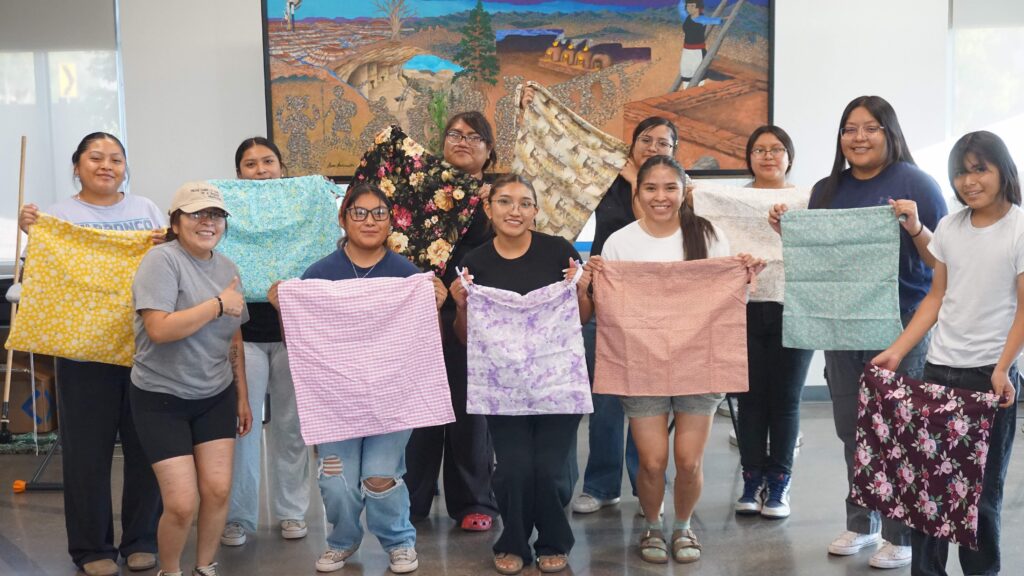

ZUNI, N.M. (July 23, 2026) — Eleven art apprentices at the Zuni Youth Enrichment Project are putting the finishing touches on their first handmade garments as they prepare for a public showcase on Friday, July 31, at Ho’n A:wan Park. Community members are invited to attend the event, meet the artists and celebrate the culmination of their 10-week Emerging Artist Apprenticeship in Pueblo sewing.
The showcase, scheduled for 5 to 7:30 p.m., marks the conclusion of the intensive program. Supported by the Bezos Family Foundation and First Nations Development Institute, this cohort of 11 students started May 26, with the last class scheduled for July 30.
The top four students — Gabrielle Baca, 18; Synthea Natewa, 21; Kalil Edaakie, 22; and Tairia Sepo-Owaleon, 22 — will then have an opportunity to travel with ZYEP to Santa Fe, New Mexico. They will showcase their work at Keshi the Zuni Connection on Aug. 15-16.
They also will experience one of the busiest weekends of the Native art calendar. The Santa Fe Indian Market, the Free Indian Market and the Pathways Indigenous Arts Festival all take place the same weekend.
Launched in January 2022, ZYEP’s Emerging Artist Apprenticeship provides opportunities for young adults to learn directly from artists in their own community. The program combines technical instruction, mentorship, cultural learning and art-show training to grow the next generation of Zuni artists and culture bearers.
In the current apprenticeship, instructors Raelynn Seowtewa and Trinnie Laweka introduced students to garment construction, sewing techniques, artistic design and the business skills that can help prepare them for careers as Zuni artists. All 11 students, including one 13-year-old and 10 young adults ages 18 to 24, entered the program as beginners.
“Teaching the students the basics of sewing and how to sew Pueblo-style attire makes me proud,” Laweka said. “As a student five years ago, I know how students feel coming into this sewing course. Becoming a ZYEP instructor has shown me that I have grown and learned more to share with students.”
According to ZYEP Arts Coordinator Elroy Natachu Jr., the program began with the fundamentals. Apprentices learned to sew by hand, and then they had an opportunity to work with Singer sewing machines, which represented a significant financial investment by the youth project.
“There was some hesitation with the sewing machines at first,” Natachu said. “There’s a learning curve if you’ve never done it! But they became more confident, and they’ll be able to take the machines home at the end of the program so they can keep practicing and creating new garments.”
Over the course of the 10 weeks, the young people worked on two primary projects: a long-sleeve shirt and a woman’s underdress. At the July 31 showcase, they will display their finished pieces, with many apprentices also offering garments for sale. The top four students are saving their garments for the Santa Fe trip, so those pieces will be for display only.
Natachu said the biggest skills-related challenges the students faced during the apprenticeship involved taking measurements and cutting material.
“They had to consider how to make something that’s more fitted or something that’s looser,” he explained. “Everyone has a different body shape, and that affects every decision you make.”
Those decisions include fabric selection, which involves balancing practicality, cost and ease of construction. Most apprentices started with cotton because of its forgiving nature, but others experimented with more challenging materials such as silk and satin.
Rather than simply providing answers, instructors encouraged the students to think critically as they encountered obstacles.
“It’s been interesting to see them struggle and then pivot to try new things,” Natachu said. “When they ask questions, we help and guide them, but over time, they learn how to think through the problem on their own.”
Seowtewa said one of the most rewarding parts of the apprenticeship has been watching students discover their own creative voice.
“I’ve seen how they can create their own unique designs, and each student has their own creativity and imagination to apply to their projects,” she said. “Some are still testing their abilities, but once they figure it out, they can overcome their fears and do it on their own.”
Technical skills are only part of the curriculum. Students also learn how to present themselves as professional artists.
“Staff members have been practicing different scenarios with them based on what we’ve seen and experienced ourselves,” Natachu explained. “We want those situations to feel less overwhelming so they won’t feel as nervous.”
For many young artists, those conversations can be among the most difficult parts of the job. Many are shy and introverted, yet entering the world of art markets requires them to embrace the Western model of “presenting,” as Natachu observed.
“Culturally, we learn to be humble and not to show off, but to survive in the Western art world, we have to be able to talk about ourselves in a healthy way while remaining culturally aware,” he said. “In the apprenticeship program, we build confidence in a highly supportive environment. We’ve been through this ourselves and have learned what will and won’t work. The program might not be as impactful otherwise.”
Seowtewa said she’s excited to see how the students present themselves to the public.
“I can’t wait to see them come out of their shells and become better communicators in their new entrepreneurial environment,” she said. “To show how proud they are of themselves and be encouraged not only by their families but also by community members who believe Zuni culture and traditions should be passed on.”
“I would love to see the community praise our students, who have worked so hard, and buy the beautiful items they have,” Laweka added. “I also hope the students will maintain their skills and have the confidence to take orders to start their businesses.”
The Emerging Artist Apprenticeship will continue this fall with a new cohort focused on beadwork. Led by instructors Vanicka Neha and Aidan Banteah-Yuselew, the apprenticeship begins Aug. 17 and concludes Oct. 21, with a public showcase scheduled for Oct. 23 at Ho’n A:wan Park.
The top four students will travel to Grand Canyon National Park in October to participate in the Grand Canyon Cultural Demonstration Program.
To learn more about the Zuni Youth Enrichment Project and its programs, and for information about making donations, partnering with ZYEP, and volunteering, call (505) 782-8000 or visit zyep.org. To stay up to date on the latest news and events, follow the nonprofit youth organization on Facebook (/zuniyouthenrichmentproject), Instagram (@zuniyouthenrichmentproject), YouTube (/ZuniYouth), and TikTok (/zyep09).
Founded in 2009, the nonprofit Zuni Youth Enrichment Project is dedicated to promoting resilience among Zuni youth so they will grow into strong, healthy adults who are connected with Zuni traditions. ZYEP fulfills its mission by providing positive role models, enriching programs, and nurturing spaces that contribute to the healthy development of Zuni youth. ZYEP strives to provide every child with the encouragement and opportunities they need to reach their full potential.