
ZUNI, N.M. (Aug. 25, 2026) — Just two weeks after completing the Zuni Youth Enrichment Project’s 10-week Emerging Artist Apprenticeship in Pueblo sewing, four young Zuni artists took their handmade clothing to Santa Fe for one of the largest gatherings of Indigenous artists in the world.
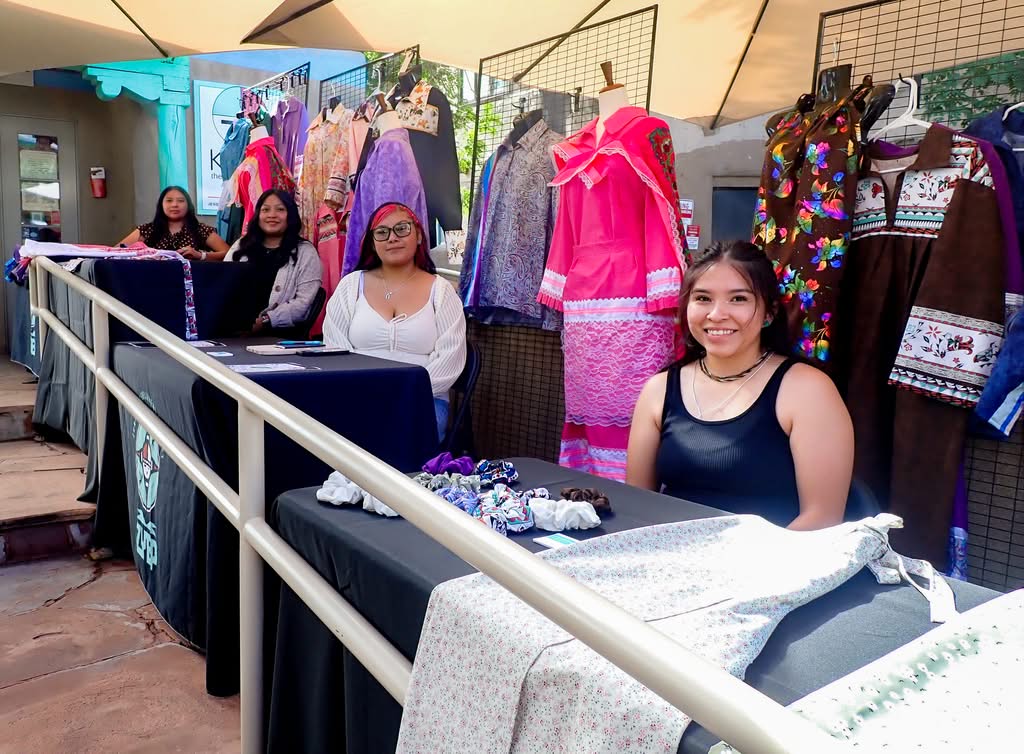
Gabrielle Baca, 17; Kalil Edaakie, 23; Synthea Natewa, 21; and Tairia Sepo-Owaleon, 23, showcased and sold their work Aug. 15-16 at Keshi the Zuni Connection, a gallery located two blocks from the 104th Santa Fe Indian Market. The four were the top students in ZYEP’s summer sewing apprenticeship, which concluded with a public showcase July 31 at Ho’n A:wan Park in Zuni.
The young artists kept sewing after the apprenticeship ended, building their inventories and experimenting with new techniques and materials. By the time they left for Santa Fe on Aug. 14, they had packed a large garment bag with dresses, casual skirts, shirts, wrap-around pants, scrunchies and other pieces.
“We could feel the energy in Santa Fe already,” said ZYEP Executive Director Tahlia Natachu-Eriacho, who chaperoned the trip with Food Sovereignty Leader Khass Hattie. “The girls were nervous. This is one of the area’s biggest weekends.”
The annual Santa Fe Indian Market brings together Indigenous artists and visitors from around the world. The Free Indian Market and Pathways Indigenous Arts Festival also took place the same weekend.
For two of the apprentices, it was their first time experiencing market weekend, and the other two hadn’t attended in years. At Keshi, they set up on the sidewalk and along the gallery steps; on the other side of the steps, Zuni potters and fetish carvers set up their own tables.
Natachu-Eriacho said the location ultimately proved ideal. The group saw steady foot traffic without the intensity of the main market, giving the apprentices room to practice engaging with customers and talking about their work.
“People had questions about the art, but they also wanted to know more about ZYEP programming,” she said. “There was a shared appreciation for the girls and the dedication and hard work it took to get to this point. I was glad they were hearing that from strangers and not just from us. It’s more powerful.”
Some of those conversations were with older Pueblo women who sew, creating opportunities for the young artists to connect across communities and generations. Sepo-Owaleon sold an entire clothing set to a woman from Taos Pueblo.
Edaakie said those interactions changed the way she viewed her art.
“Every interaction, whether someone was purchasing a piece, admiring our work or offering advice, gave me more confidence and inspired me to keep creating and progressing,” she said. “Having other people appreciate the details and work that went into our garments also made me see my own work differently and recognize how far we’ve come since we first started learning.”
Sepo-Owaleon agreed, commenting, “In the beginning, I was unsure about applying for the class, but the opportunity opened a new path for me. This class not only taught me a new hobby, it gave me a confidence boost.”
She saw that growth in her fellow apprentices too, noting that the experience brought them all out of their shells.
“Watching from the side while they spoke about their pieces, it showed me that we all grew together, getting a taste of the professional art world,” she explained. “That encourages me to hone this skill and see where it can take me.”
Apprenticeship instructors Raelynn Seowtewa and Trinnie Laweka accompanied the ZYEP staff and apprentices on the trip, and Seowtewa described a similar transformation.
“For me, it was watching the girls bloom from their shy selves into sunflowers,” she said. “I think the best thing was seeing them do it on their own — talking to customers, talking about their pieces and taking orders like pros.”
The instructors spent more than 10 weeks teaching 11 young artists through the ZYEP Emerging Artist Apprenticeship, which was made possible with support from the Bezos Family Foundation and First Nations Development Institute. They learned sewing, garment construction and design, along with the business and communication skills necessary for presenting their work professionally.
“It was important for the girls to see what’s outside of Zuni, and to see the different types of fashion that they can create,” Laweka said. “To see where fashion can take them in their new adventure.”
The weekend also gave the group a chance to connect with other Zuni artists participating in the Santa Fe Indian Market. ZYEP Arts Coordinator Elroy Natachu Jr. and Arts Leader Kandis Quam were exhibiting through their own art business, while Edaakie’s father, a fetish carver, had a booth as well.
“Walking through Indian Market and seeing the work and different styles of other artists was inspiring,” Edaakie said. “It made me think about how I can continue growing creatively while honoring the traditional clothing we’ve been learning to make and finding ways to bring my own contemporary approach to it.”
For Natachu-Eriacho, seeing Zuni artists at an international gathering of Indigenous people brought a deep sense of pride and perspective.
“We grew up immersed in art in Zuni,” she said. “There’s always an art room or a work shed at home. It’s just part of life, and sometimes you don’t fully appreciate what you have at home until you step outside of it and see it through other people’s eyes.”
Natachu-Eriacho acknowledged that working closely with a Santa Fe gallery is an interesting development for a nonprofit organization that encourages customers to support Zuni artists directly. The history involving Native artists and non-Native traders and galleries is a complicated one.
“We can’t change history, but we can acknowledge it and take it into account as we move forward together in a good way,” she said. “For us, this is part of the process of reconciliation, and we are so appreciative of this opportunity to support our artists and community.”
ZYEP also expressed gratitude to Keshi for providing the young artists with food and refreshments. The gallery even hired a caterer from Santo Domingo Pueblo for the weekend.
“It was such a wonderful experience all around,” Natachu-Eriacho said. “I loved hearing the girls connect over their shared passion. They talked constantly about their customer interactions, ideas they want to try and what they learned.”
Laweka agreed that the weekend was a transformative one, noting that it gave her a sense of confidence and the “girl power and unity that I needed.”
ZYEP’s Emerging Artist Apprenticeship continues this fall with a new cohort focused on beadwork. Led by instructors Vanicka Neha and Aidan Banteah-Yuselew, the apprenticeship concludes Oct. 21, with a public showcase scheduled for Oct. 23 at Ho’n A:wan Park. The top four students will travel to Grand Canyon National Park in October to share their skills and artwork through the Grand Canyon Cultural Demonstration Program.
To learn more about the Zuni Youth Enrichment Project and its programs, and for information about making donations, partnering with ZYEP, and volunteering, call (505) 782-8000 or visit zyep.org. To stay up to date on the latest news and events, follow the nonprofit youth organization on Facebook (/zuniyouthenrichmentproject), Instagram (@zuniyouthenrichmentproject), YouTube (/ZuniYouth), and TikTok (/zyep09).
Founded in 2009, the nonprofit Zuni Youth Enrichment Project is dedicated to promoting resilience among Zuni youth so they will grow into strong, healthy adults who are connected with Zuni traditions. ZYEP fulfills its mission by providing positive role models, enriching programs, and nurturing spaces that contribute to the healthy development of Zuni youth. ZYEP strives to provide every child with the encouragement and opportunities they need to reach their full potential.